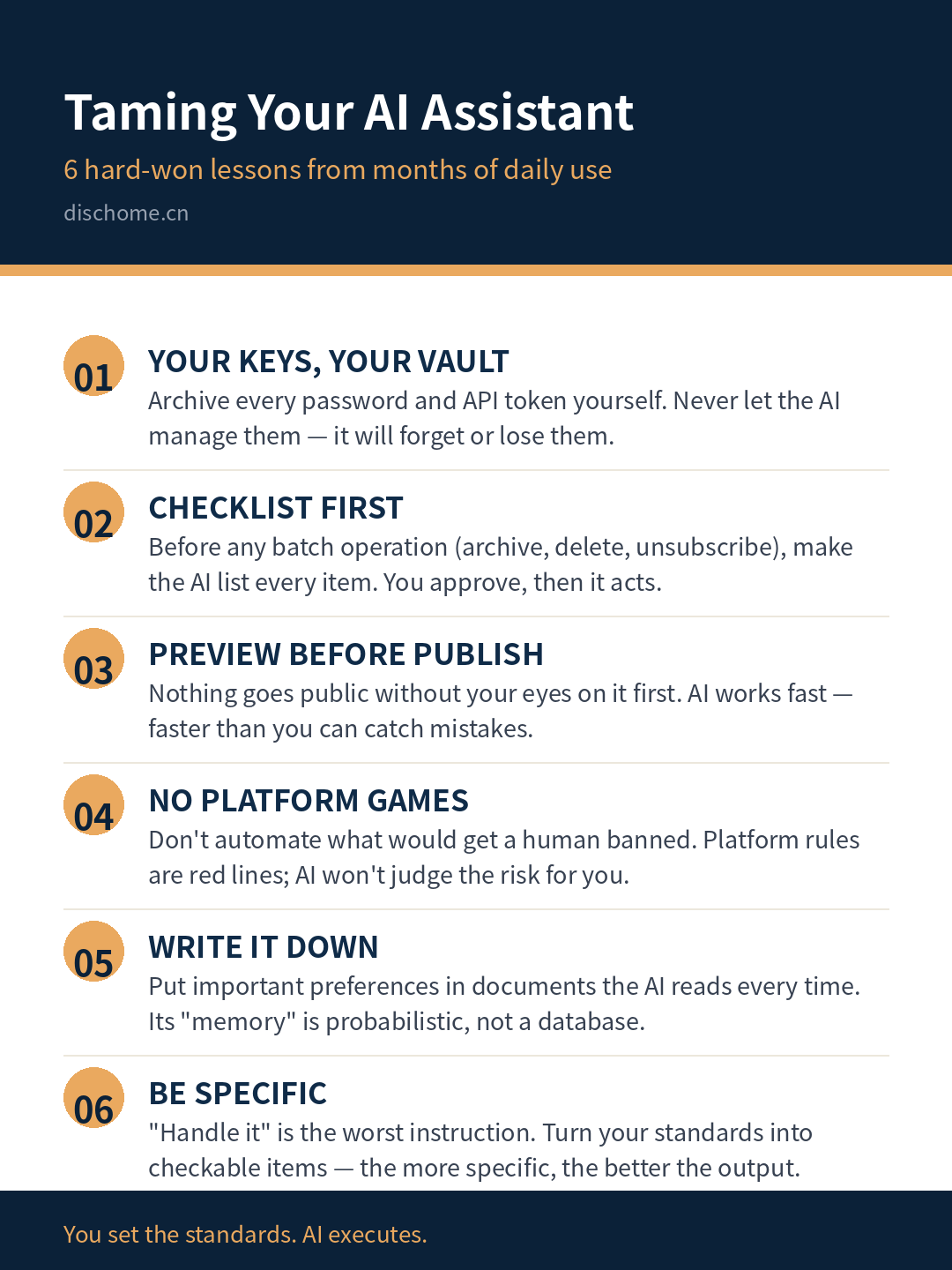
I've been using an AI assistant for the better part of a year now — account setups, content graphics, market monitoring, website ops — nearly every chore handed off to it. As good as it is, the pitfalls are real. This post collects the ones I've stepped in; behind each is a genuine lesson.
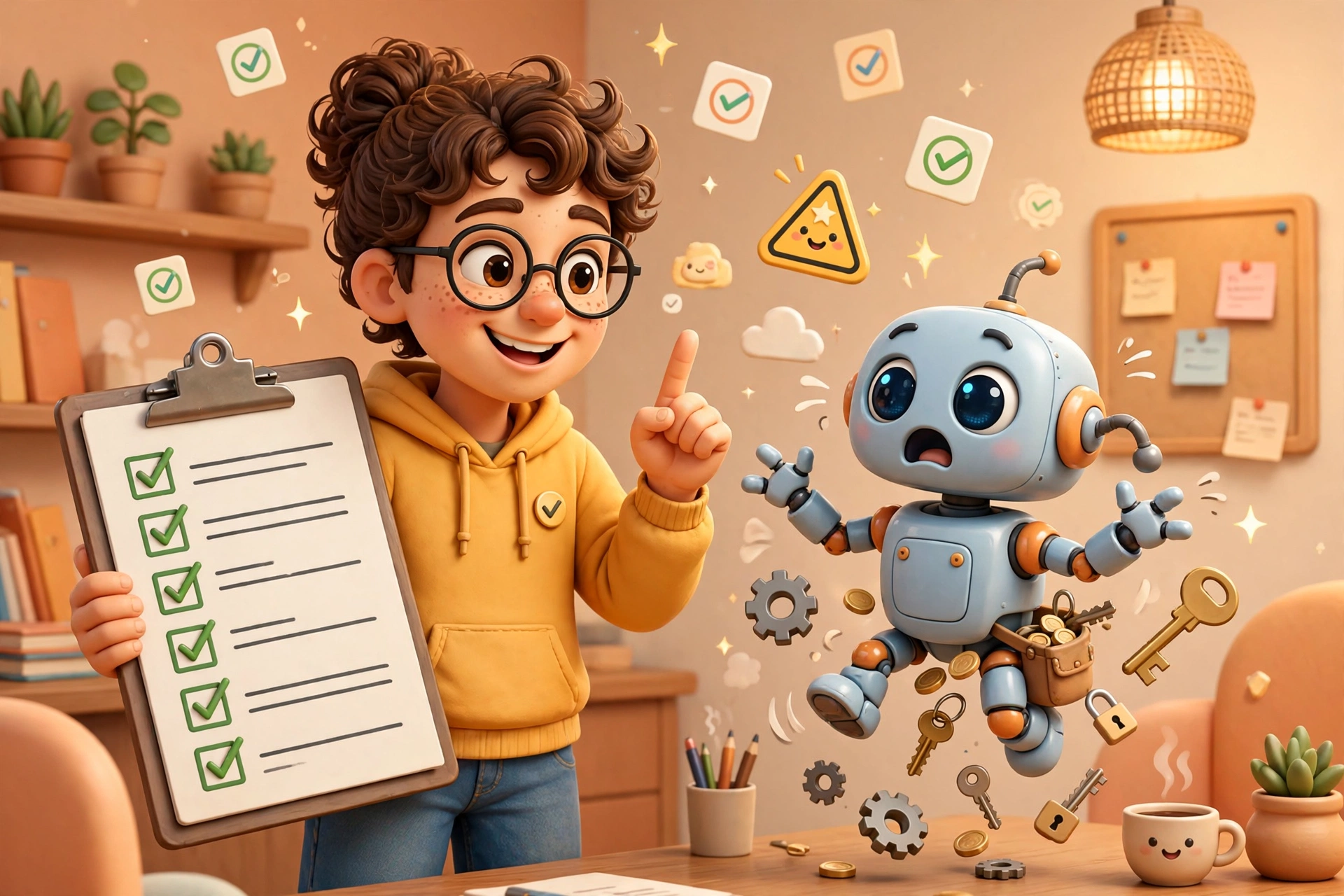
Rule #1, and the most important one: archive your fixed assets yourself — never let the AI manage them
Every account, password, and API token must be archived by you, personally. Never let the AI manage them on its own. It will forget them or lose them.
My painful case in point: during a website migration, I told it "you handle the passwords." The temporary migration credentials never got saved — not in its notes, not in the vault. When I needed them, they were gone, and I was forced through the password-recovery process twice. An entire day, wasted.
Since then I've had one iron rule: every password is set by me and entered through a secure channel; the AI only fills it in when needed — never setting, never memorizing, never managing passwords on my behalf. If I ever say "you handle the passwords" again, it's supposed to throw this story back in my face.
Why? Because an AI's "memory" is unreliable. What it remembers is scattered across conversations, files, and every odd corner — with no single, auditable vault. And with passwords, the cost of losing one far outweighs the hassle of entering it yourself each time.
Before batch operations, demand the list first
Once I told it to "archive all the other emails." Without a word, it archived all 887. Among them were real messages from real people — meeting invites, billing notices — swept up with the junk.
The lesson: for batch actions like unsubscribing, archiving, or deleting, make the AI list every item first and wait for your nod before it touches anything. It can't tell "looks like junk" from "is junk." That judgment is yours to make.
Preview before publishing
Websites, graphics, blog posts — anything going public must be shown to me for preview after changes, never shipped directly.
AI works fast — too fast to react to. Once it deployed a website change before I looked; only then did I spot a detail that was off. Rolling back is easy, but a publicly shown mistake can't be unshown.
Don't let AI game the platforms for you
I once had it auto-post comments with referral codes on X for promotion. The account got frozen — a new account posting promo-coded content at high frequency was flagged as a spam bot.
The lesson: platform rules are red lines, and AI won't judge for you whether something will get you banned. For anything involving bulk outreach, promotion, or marketing automation, ask yourself first: would a human get banned for doing this? If yes, the AI doing it is no different.
Write important preferences down — don't count on it remembering
An AI's memory is probabilistic, not a database. A preference you mentioned once in passing, it may remember, misremember, or forget next time.
My approach: every important rule goes into a document, stored where the AI reads it every time it works. "Review before batch ops" goes into the preferences doc; "I manage my own passwords" is an iron rule. Every time it makes a mistake and I correct it, the correction becomes a new written rule. That way the kinds of mistakes it makes keep shrinking, instead of stepping in the same hole twice.
The more specific your instructions, the better
"Handle it" is the worst instruction. The AI will "handle it" according to its own understanding, and the result is rarely what you wanted.
Compare:
- Bad: "Make the blog post better"
- Good: "Use noun-phrase headings, connect paragraphs with transition sentences, no sloganeering at the end"
Say your standards out loud and turn them into checkable items. The more specific you are, the more accurate it gets. Skip the trouble of spelling it out, and you get average output.
Closing
An AI assistant is a powerful executor, but it's not your clone. It doesn't have your judgment or your sense of risk, and its "remembering" is not the same as yours.
The right posture: you set the standards, you make the judgments, you take final responsibility; it executes, it's fast, it never complains. Get that division of labor right, and most of the pitfalls disappear.